Mini Split Installation in Summerville, SC
A new system here will heat from November through March and cool from May through October every year. Tell us about the house, and a licensed contractor who covers Dorchester County will get in touch.
Tell us about the job
It takes about a minute.
Eleven months of work for one system
In Summerville, a mini-split works almost year round. Summers run hot, with afternoons averaging 91°F, and homes need cooling May through October, six months straight. Winter is shorter but still real, with nights averaging 38°F from December through February and heat needed November through March. That leaves only a handful of weeks when the system gets to rest.
Any mini-split installed new has to meet the federal minimum for a split-system heat pump, 14.3 SEER2 for cooling and 7.5 HSPF2 for heating. In a climate that calls on both sides of that rating almost every month, the unit installed matters as much as the installation itself.
- 5 months
- November through March, your system heats
- 6 months
- May through October, it cools
- 38°F
- the average winter night it heats against
- 91°F
- the average summer afternoon it cools against
NOAA nClimDiv, 1991–2020 normals
- Is a mini split worth it?
- For most homes here, yes. Summerville needs cooling six months a year and heat the other five, so a system that runs efficiently at both jobs stays busy nearly every month. A mini split's outdoor heat pump unit meets the federal minimum of 14.3 SEER2 for cooling and 7.5 HSPF2 for heating, so it handles summer afternoons near 91°F and winter nights near 38°F without switching to a separate heating system. It also skips the duct losses a central system has, which matters if you're adding capacity to a room the ducts don't reach well.
- How many rooms can a mini split cover?
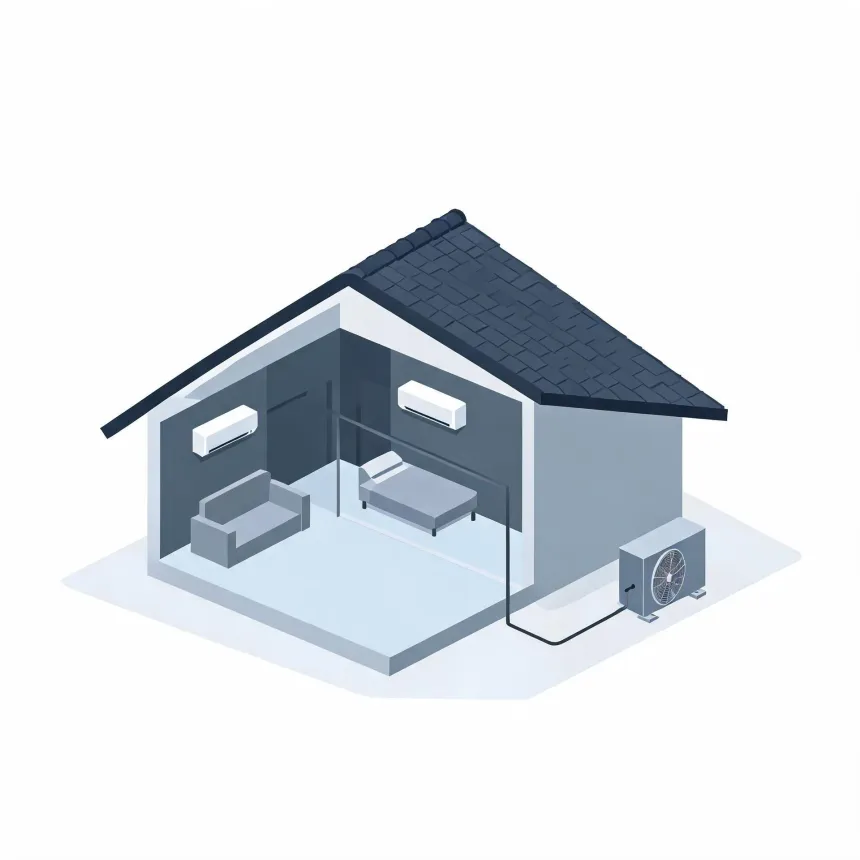
- A single outdoor unit can run one indoor head or several, depending on the system. A single-zone system heats and cools one room. A multi-zone system ties one outdoor unit to multiple indoor heads, each with its own thermostat so different rooms can run at different temperatures at once. How many rooms one outdoor unit can support depends on the total heating and cooling load of those rooms, which a contractor works out by measuring the space, not by counting doors.
- Can a mini split heat a whole house?
- It can, if enough indoor heads are installed to cover every room and the outdoor unit is sized for the whole house's heat loss. Multi-zone systems are built for this, with one outdoor unit feeding heads in each room or living area. Whether it makes sense for a specific house depends on the layout and how much heat that house loses on a 38°F night, which is something a contractor needs to calculate room by room before sizing the system.