
Water Heater Repair in Georgetown, SC
Tell us what your water heater is doing, and a licensed contractor who covers Georgetown County will get in touch.
Tell us about the job
It takes about a minute.

What Georgetown winters do to a water heater
Georgetown doesn't get hard freezes often, but from November through March, five months a year, water heaters work harder to bring cold groundwater up to temperature. On nights that average 38°F, a tank that used to keep up now runs longer to hold the same setting, and that extra runtime wears on the heating element and the thermostat that controls it.
Power is the bigger risk here. Nearly half of South Carolina households lost power for at least 24 hours in 2024, and the county has logged 45 damaging wind events over the past ten years. When the power drops and comes back, most electric water heaters restart on their own, but a gas unit with an electronic igniter may not relight without help. If your water heater sat cold after the last outage, that's usually why.
- 38°F
- the average winter night, and colder incoming water means longer heating
- 5 months
- November through March, the months homes here need heat
- 45%
- of South Carolina households lost power for a day or more in 2024, and a heater with an electric element or electric ignition stops without it
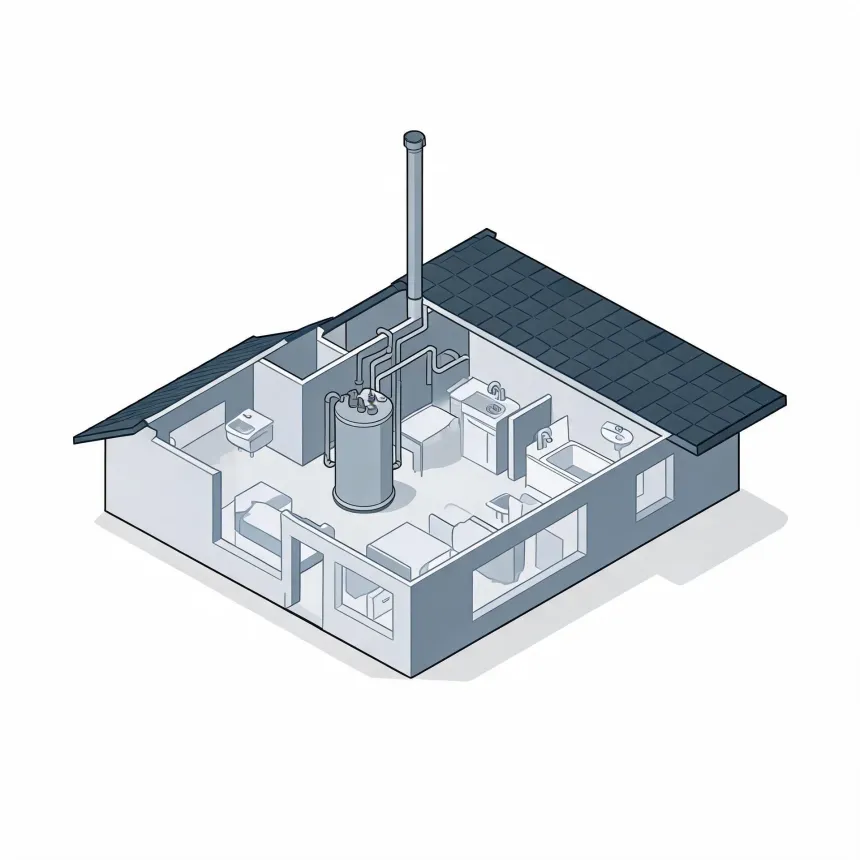
NOAA nClimDiv, 1991–2020 normals
A new water heater would cut about $300 a year off hot water for a typical South Carolina home.
Estimates for a typical South Carolina home, compared with an older unit built to the federal minimum, from EIA household energy data and South Carolina fuel prices. Your home will differ.
Repair makes sense when an element, thermostat or gas valve has failed.
Replacement makes sense when the tank itself is leaking.
- Why is my water heater leaking from the bottom?
- The most common cause is the tank itself failing from the inside, where years of sediment and rust eat through the metal until water seeps out at a seam or fitting. It can also be a loose drain valve, a failed temperature and pressure relief valve, or fittings that have simply worked loose over time. A tank leaking from a crack in the steel cannot be repaired and needs to be replaced. A contractor can tell you within a few minutes which one you are dealing with, since a valve or fitting leak looks and feels different from a tank that has rusted through.
- Why won't the pilot light on my water heater stay lit?
- Most often this means the thermocouple has worn out and can no longer sense the flame, so the gas valve shuts off as a safety measure. It can also be a dirty pilot orifice, a draft blowing the flame out, or a bad gas valve itself. A thermocouple is a simple, inexpensive part to replace and is the first thing worth checking. If the pilot relights fine but goes out again after a few minutes, that points straight at the thermocouple.
- Can a tankless water heater be repaired?
- Yes, most problems with a tankless water heater are repairable rather than a reason to replace the unit. Common issues include a clogged inlet filter, mineral scale buildup on the heat exchanger, a failed igniter, or an error code pointing to a specific sensor. Scale buildup is worth asking about directly, since it can be flushed out and prevented with regular maintenance. A contractor can pull the error code and tell you which part is at fault.