
Signs of leaky ductwork in Charleston, SC
One request and the search for a pro is handled.
Hand it offWhat are the signs of leaky ductwork in my Charleston home?
You've noticed something isn't quite right, maybe a room that never cools down, or a power bill that keeps climbing, and you're wondering if the ductwork is to blame. Leaky ducts don't announce themselves the way a broken fan does. You have to know what to look for, and with how hard your AC works through a Charleston summer, it's worth catching early rather than living with it.
Uneven cooling and a higher power bill are the main signs
If one or two rooms stay warm while the rest of the house feels fine, air is escaping somewhere between the unit and the vent. A power bill that keeps climbing without any change in how you run the system points the same direction. You might also notice weak airflow at certain vents, dust gathering faster than usual, or ducts running through the attic or crawlspace that feel hot or damp to the touch. In Charleston, where the AC runs for months at a stretch, a leak means conditioned air is being pushed into the attic instead of your living room, and humid outside air can get pulled into the system. The system works harder and your home still doesn't feel right.




Duct Leak or Something Else
Duct leak
- One or two rooms stay warm all summer while the rest of the house feels fine, especially rooms farthest from the air handler.
- The attic or crawlspace feels cooler than it should near a duct run, since the air meant for your living room is leaking out there instead.
- Your power bill climbs even though you haven't changed the thermostat, because the system has to run longer to make up for what it loses on the way.
- You can hear air hissing or feel a draft near a duct joint or the boot where a vent meets the floor or wall.
- Dust seems to collect faster than it used to, pulled in through gaps on the return side and blown out through the vents.
- The system cycles on and off more than it used to, working harder to hold the temperature you set.
Something else
- A room runs warm because its supply vent is partly closed or blocked by furniture, not because air is escaping the duct.
- Humidity feels high indoors even with cool air flowing, which often points to the system being oversized rather than to a leak.
- The bill went up because the outdoor unit is dirty or low on refrigerant, both of which make it run longer regardless of the ducts.
- A musty smell can come from a clogged condensate drain or a damp filter, not from air escaping into the attic.
- Uneven cooling between floors is common in two-story homes simply because heat rises, no leak required.
- A noisy vent is sometimes just a loose damper or a grille rattling, not air forcing its way out of a seam.
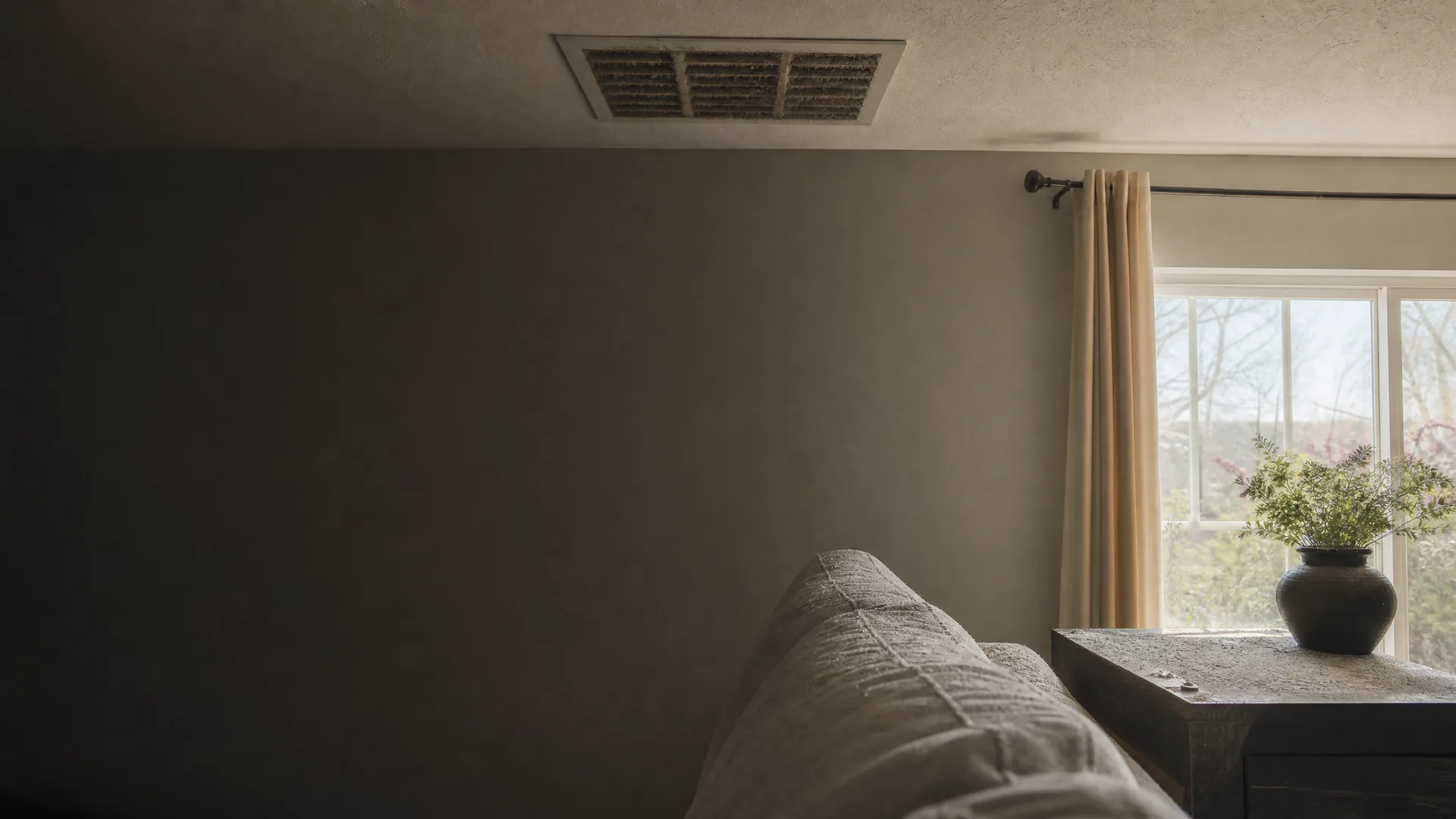
You're dusting the living room on a mild spring afternoon, windows still closed from the last cool snap, and you notice the ceiling vent grille has a gray ring of dust around it. The end table underneath has a fine film on it too, more than the rest of the room. You wipe it off and it's back within a few days. That vent sits on a duct run that passes through the attic, and if the duct has a leak or a loose seam near that register, it can pull dust and attic air through the gap and push it out into the room along with the cooled air.



Air leaves the air handler through the supply trunk at full force.
Pressure pushes air outward at every joint, seam and connection.
Loose or cracked joints let conditioned air escape into the attic or crawlspace.
Rooms farthest from the air handler get less air than they should.
Why do leaky ducts show up so fast in a Charleston house?
Half the homes here were built by 1991
Half the homes in Charleston County were built in 1991 or earlier, and duct runs that old have had decades of joints to work loose.
Heat runs November through March
Cooling runs May through October here, about six months straight, so a leak in the duct run gets worked hard for half the year.
Cooling runs May through October
Heat only runs November through March, but a leak that wastes electric heat for five months still shows up on the bill.
ACS 2020-2024 · NOAA nClimDiv 1991-2020


One request and it's handed off

The pro who gets in touch is licensed in South Carolina and works in Charleston County.
Sending the form costs nothing.
In your house, a duct leak shows up as a bedroom down the hall that never quite cools off, no matter where you set the thermostat. It shows up as a power bill that climbs a little more each August without anything else in the house changing. Run your hand along a duct seam in the attic or crawlspace on a July afternoon and you might feel cool air moving against your palm, air you paid to condition that never made it to a vent. Leave it alone and the air handler keeps running longer to make up the difference, which wears on the blower and the compressor over time. Dust rings around your vent grilles are another tell, since a leaky return pulls in attic or crawlspace air and pushes the dust it carries right into the room. None of this fixes itself. A duct that's lost a joint or cracked a seam stays that way until someone seals it, and every month it goes unnoticed is a month you're paying to heat or cool a space you'll never sit in.
Power here costs 16.39 cents per kilowatt-hour
At 16.39 cents per kilowatt-hour, every cubic foot of air your ducts lose outside is still metered and paid for. A leak that cools the attic instead of your bedroom doesn't lower the bill, it just makes the air handler run longer to make up the difference.
EIA-861 2025
Living with a leak for now
You can work around a duct leak for a while. Shut the door to the room that never cools down and run a window unit in there instead. Keep the thermostat a couple of degrees cooler than you'd like so the far bedrooms get closer to comfortable. Check the attic or crawlspace once in a while for the dust rings and the loose joints, so you know if it's getting worse. Plenty of people live this way for a season or two without much trouble, especially if the leak is small and the rest of the house holds its temperature fine. It costs you something every month in wasted power, but it's not an emergency, and nothing about a duct leak forces your hand right away.
Having it sealed instead
Sealing the duct run stops the leak where it is instead of working around it. A contractor who services equipment in Charleston County every summer knows which joints give out first and where to look before guessing. Once the run is sealed, the air you pay to cool goes to the room it was meant for, not the attic above it. The far bedroom gets the air that was leaking out along the way, and the air handler isn't working as hard to make up for it. You stop checking the attic for dust rings because there's nothing new collecting there. It's a repair, not a workaround, and once it's done you're not thinking about that duct run again.


What a Duct Leak Tells You
- A room that never cools down, dust rings around the vents, and a bill that keeps climbing all point to the same leak.
- A local contractor who services Charleston County ductwork every summer knows which joints and connections tend to give out first.
- You'll hear back from one licensed contractor, not a handful of companies competing for the job.
- Fixing a sealed, straight duct run means the air you're paying 16.39 cents a kilowatt-hour for actually reaches your living room.
- A duct leak doesn't fix itself, and it costs you every month it runs through a Charleston summer.
The signs point the same direction every time. A room that stays warm no matter what the thermostat says, a gray ring of dust around a vent grille, a bill that creeps up each August without anything else changing in the house. Put two or three of those together and the ductwork is the reason, not the air handler and not the thermostat setting. Half the duct systems in Charleston County date to 1991 or earlier, and a run that old has had a long time for a joint to work loose or a seam to sag. Six months of cooling a year puts real pressure on those same joints, over and over, which is why a leak that started small tends to show up clearly by the time summer is half over.
Finding the leak is a different job than noticing it. A duct run can hide behind drywall, above a dropped ceiling, or along joists in a crawlspace you don't walk through often, and tracing it back to the exact loose joint takes someone who does this work on Charleston County homes all season. That's one licensed, local contractor, not several companies calling about the same job. Someone who has sealed duct runs in this county before knows where the connections tend to fail first, because the houses here share the same age and the same long cooling season. Once that run is sealed and running straight to the air handler, the air you're paying for stops cooling the attic and starts cooling your living room, which is the only place it was ever supposed to go.

Ductwork Cleaning
Done looking for a duct system pro

- Get matched with someone who does this kind of work in Charleston County.
- Get matched with a Charleston County pro who cleans ducts.

- One request and the duct cleaning stops waiting on you.
- Once you send the form, finding a pro is off your list.

- Skip searching for someone who cleans ducts in Charleston County.
- Describe your ductwork job once, to one pro.

- Your request goes to one pro, not a list of companies.
- The pro who reaches out is licensed in South Carolina.