Side profile of a bearded man wearing a faded dark blue baseball cap and a matching dark T-shirt against a plain light gray background.

Why your house is so dusty in Greenville, SC

Duct and vent cleaningDucts or ventsGreenville County, SC
Step 1 of 2

What ZIP code is the job in?

Why is my house so dusty in Greenville, SC?

You dust the shelves on Sunday and by Wednesday there's a film on them again. It's not your housekeeping. Something is putting that dust back into the air faster than you can wipe it away, and in most houses around Greenville, the answer is sitting in the attic or a closet: the duct system that moves air through every room.

Your ducts are pulling in dust and spreading it through the house

Forced air systems run almost constantly here, with long muggy summers and cold winters both keeping the blower working. Every time it runs, air moves through ductwork that can have gaps, loose joints, or a buildup of dust inside that gets stirred up and pushed back into your rooms. A dirty filter makes it worse, since it stops catching what it should and lets more particles circulate. The duct system is the delivery path for whatever is in your air, so if dust keeps coming back no matter how often you clean, the ducts themselves are usually where it's building up and recirculating.

Unfinished basement corridor with exposed wood floor joists, pipes and wiring overhead, sheet-metal HVAC ductwork and an electrical panel along the left wall, and a blank white wall on the right.

Your ducts run almost year round

Summers here get sticky and run long, and winters are cold, so the system pushing air through your ducts is on for most of the year. Every time it cycles, it pulls air through the return and pushes it back out through every room. If there's dust sitting in that ductwork, or a gap where it draws in air from the attic or crawlspace, the blower is handing you a fresh supply of it on a steady schedule.

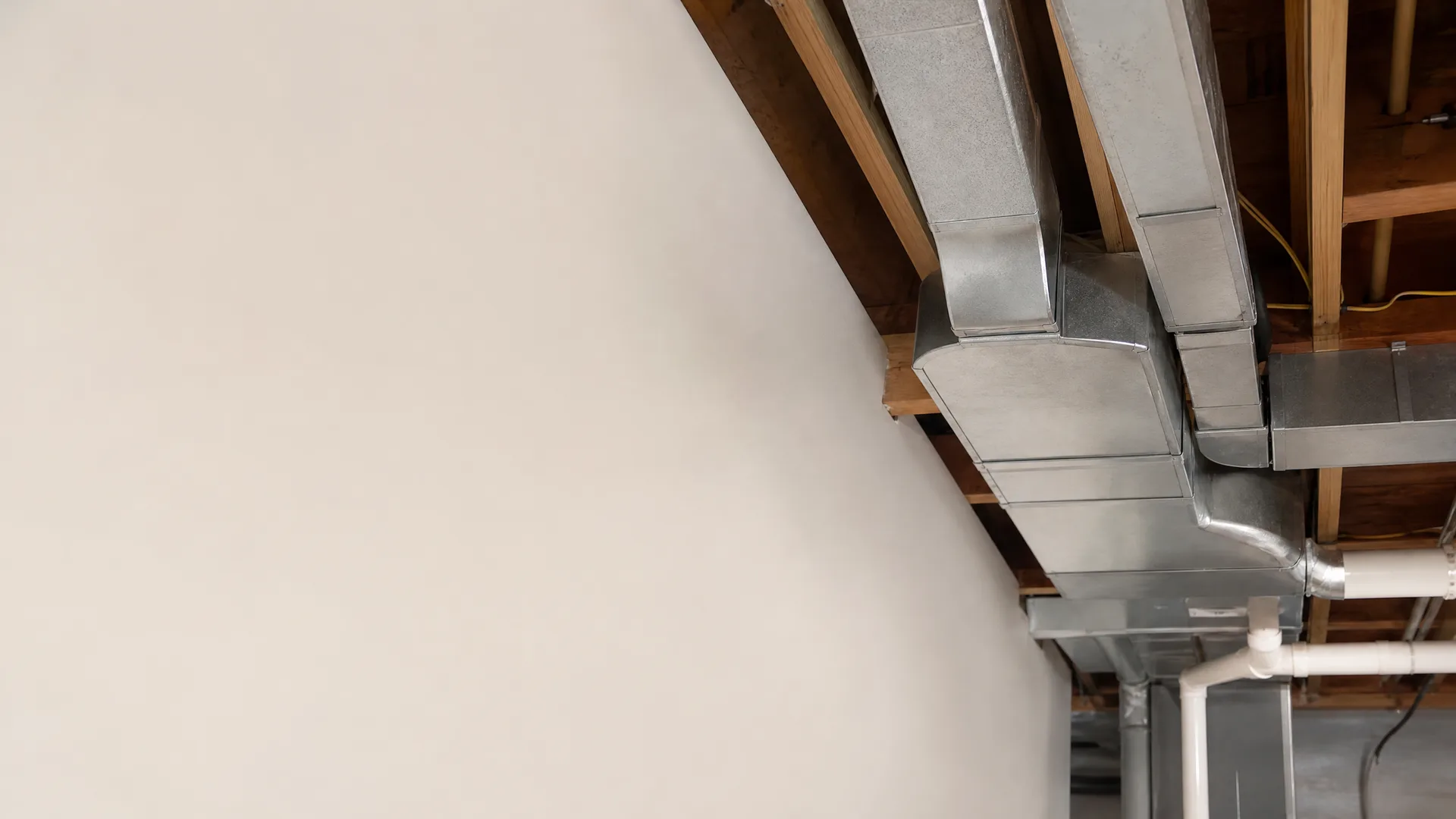
Interior basement ceiling with exposed wooden joists, sheet-metal HVAC ducts, and white PVC pipes beside a plain off-white wall.

The filter only catches so much

Air has to pass through the filter before the system can heat or cool it, but a filter that's clogged or too thin for the system lets fine dust slide past instead of trapping it. A filter rated for basic dust won't stop the finer particles that settle on shelves and furniture. Once dust gets past the filter, it rides the airflow through the ducts and back into every room the system serves, filter or no filter.

What's pulling dust through your ducts so much of the year?

  • Half the homes here were built by 1992

    Heat runs October through April, about seven months. That's seven months of air moving through your ducts and whatever has settled inside them.

  • Heat runs October through April

    Cooling runs May through September, the other five months. Add it to winter and the system is moving air through those ducts almost every month of the year.

  • Cooling runs May through September

    Half the homes in Greenville County were built in 1992 or earlier. Ducts that old have had decades to collect dust in seams and joints that newer duct runs haven't.

ACS 2020-2024 · NOAA nClimDiv 1991-2020

Dust that's been building for years

If the ductwork came with the house and nobody's had it cleaned, there's likely years of dust packed into the bends and the far runs where air barely reaches. A filter only catches what passes through it. It can't do anything about what's already sitting in the ducts, and every heating and cooling cycle stirs a little more of it loose. The longer it's gone, the more there is to move. A one-time cleaning takes out what's accumulated and gives you a clean starting point, something a new filter alone can't do.


Dust that keeps coming back

Some houses stay dusty even after a cleaning, and that usually points to something that keeps refilling the ducts rather than a one-time buildup. A gap in the return, a loose seam, or a spot where the ductwork draws air from the attic or crawlspace will pull dust and debris in faster than you can keep up with. Cleaning helps, but it won't last if there's a leak feeding it. That's worth a look from someone who can check the duct runs and seal what's letting the dust back in before it collects again.

A smiling woman in a cream knit sweater sits at a marble counter with a glass of red wine, with a dining table, pendant lights, and French doors in the dim background.
A smiling woman with long dark hair in a cream sweater sits in a dimly lit open-plan home interior, with a glass of red wine in the foreground and a dining table, fireplace and shelving behind her.
A woman with long dark hair in a black turtleneck laughs while seated at a light stone counter with a glass of red wine, in a dimly lit interior with a potted plant, framed pictures and a hanging lamp behind her.
A woman in a dark sweater laughs while seated at a white marble counter with a glass of red wine, in a dimly lit open-plan interior with a pendant lamp and dining table behind her.

Describe it once

The pro who gets in touch is licensed in South Carolina and works in Greenville County.

There's no charge for the request.

How a duct cleaning actually works

  • Dust in the ducts breaks loose when air speeds up at every bend, register, and takeoff in the run.
  • Static pressure from a clogged filter or closed-off rooms pulls harder on the weak joints where dust has packed in.
  • Return ducts draw in more than room air; they pull from attics, crawl spaces, or wall cavities with loose seams.
  • A duct cleaning uses a vacuum collection system at one end while agitation tools knock dust loose at the other.
  • Every branch line and the plenum gets brushed or air-whipped in turn, not just the parts you can reach by hand.
  • Registers and the coil get cleaned too, since dust settles on both long before it ever reaches a room.

A duct system moves air, and moving air carries dust with it. Every bend, every register, every place a branch line splits off the main trunk is a spot where the air speeds up and slows down, and that's where dust works itself loose from the walls of the duct. Add a clogged filter or a few closed vents in rooms you don't use, and the system has to pull harder to move the same air, which puts more strain on the joints and seams where dust has already packed in over time. It doesn't stop at the rooms you can see either. Return ducts pull air from wherever they're open to, and if a seam has worked loose in an attic or a crawl space, that's what's feeding your living room air, not just what's already inside your house.

A real cleaning works both ends of that system at once. One end runs a vacuum strong enough to collect what comes loose, while the other end uses brushes or compressed air to knock dust off the inside walls of the ducts, including the branch lines and the plenum that feed every room, not just the trunk line a shop vac could reach from a register. The registers themselves get cleaned, and so does the coil, because dust settles on both of those just as fast as it settles inside the ductwork, and a system that only cleans what's visible leaves the rest to keep feeding dust back into your rooms.

A basement with a gray furnace on a concrete pad connected to large sheet-metal ducts running along an exposed wood joist ceiling, with PVC pipes and plastic sheeting on the walls.
Here the ducts are sealed tight, the joints hold, and air moves through sheet metal and flex runs without pulling in anything extra.
Galvanized sheet metal HVAC ductwork with a vent grille running along a wooden joist ceiling above a bare concrete wall.
Here a duct seam has opened along the run, and the gap sits right above the floor joists where house dust gets pulled in and sent back out.

With your system running close to year round, that dust is doing more than sitting on the shelves you wipe on Sunday. It settles into carpet fibers, gets pulled into the return again, and keeps going around. You'll notice it on the ceiling fan blades a day after you clean them, in the dark line that forms on the wall above a register, in the film on the TV screen by Wednesday. If anyone in the house has allergies or asthma, seven months of heat and five of cooling means that much more time breathing what the ducts are putting out. A duct seam open above the floor joists or a joint packed with years of buildup doesn't fix itself, and every heating and cooling cycle keeps feeding it back into the rooms you spend your evenings in. The dusting isn't the problem. It's what's happening behind the walls and under the floor every time the system kicks on.

A smiling man with dark wavy hair and a short beard, wearing a navy crewneck sweater, sits at a candlelit dinner table with a bowl of food, wine glass and a lamp and framed art behind him.
A woman with wavy brown hair sits on a beige couch with her eyes closed and a slight smile, a knit blanket over her lap and a closed dark-covered book resting on it, with a lit lamp and plant in the dim background.
Unfinished basement with galvanized sheet-metal rectangular and round ductwork running along a wood-joist ceiling, two steel support columns, a small window, and a furnace unit against the far right wall.

Ducts holding up

This is what a duct run looks like when it's doing its job. The metal trunk and the flex runs sit tight against the joists, every joint holding, carrying air to the registers without picking up anything along the way. Nothing here is pulling in dust that doesn't belong.

An unfinished basement with bare concrete walls and floor, showing exposed wooden floor joists, pipes, wiring, and metal HVAC ducts with a vent grille overhead.

Ducts losing dust

Here the run looks fine until you notice the seams. Gaps between the joists and the branch ducts give house dust a way in every time the system cycles. Once that dust is inside, it rides the airstream to every register in the house.

Power here costs 14.44 cents per kilowatt-hour

At 14.44 cents per kilowatt-hour, running the blower longer than it needs to costs you something every month. Packed ducts raise static pressure, and the system works harder and runs longer to move the same air, pulling that bill up right along with it.

EIA-861 2025

  1. Technician inspects duct runs and registers with a camera first.

  2. Vents and takeoffs are sealed off to isolate the duct system.

  3. A vacuum unit connects to the trunk line to pull negative pressure.

  4. Compressed air agitates dust loose from every bend and joint.

A closed laptop and a ceramic mug of dark coffee sit on a wooden table, with a blurred kitchen counter, potted plant, wooden utensils and cutting boards, and a large window in the background.

So the dust isn't a mystery anymore

Your house gets dusty because your ducts run most of the year and they're carrying years of settled dust along with the air. That's the whole answer. Nothing about how you clean or how often explains it, because the dust is coming from inside the system itself, loosened at every bend and register and pulled back into the rooms you just wiped down.

Finding out who actually cleans ducts in Greenville County, and whether they'll do the job right, usually means calling around, explaining the same thing to three different companies, and sorting through quotes that aren't quite comparing the same work. A local contractor who deals with this kind of buildup every season already knows what to check first and what usually needs sealing along the way. You'd hear back from one person who knows the job, not a handful of callbacks to sort through.

Interior corner of a room with a dark upholstered sofa and textured cushion, a potted plant, sheer curtains at a multi-pane window showing blurred green and yellow trees, and a dark table holding a wooden tray with stacked coasters and a small ceramic vase.
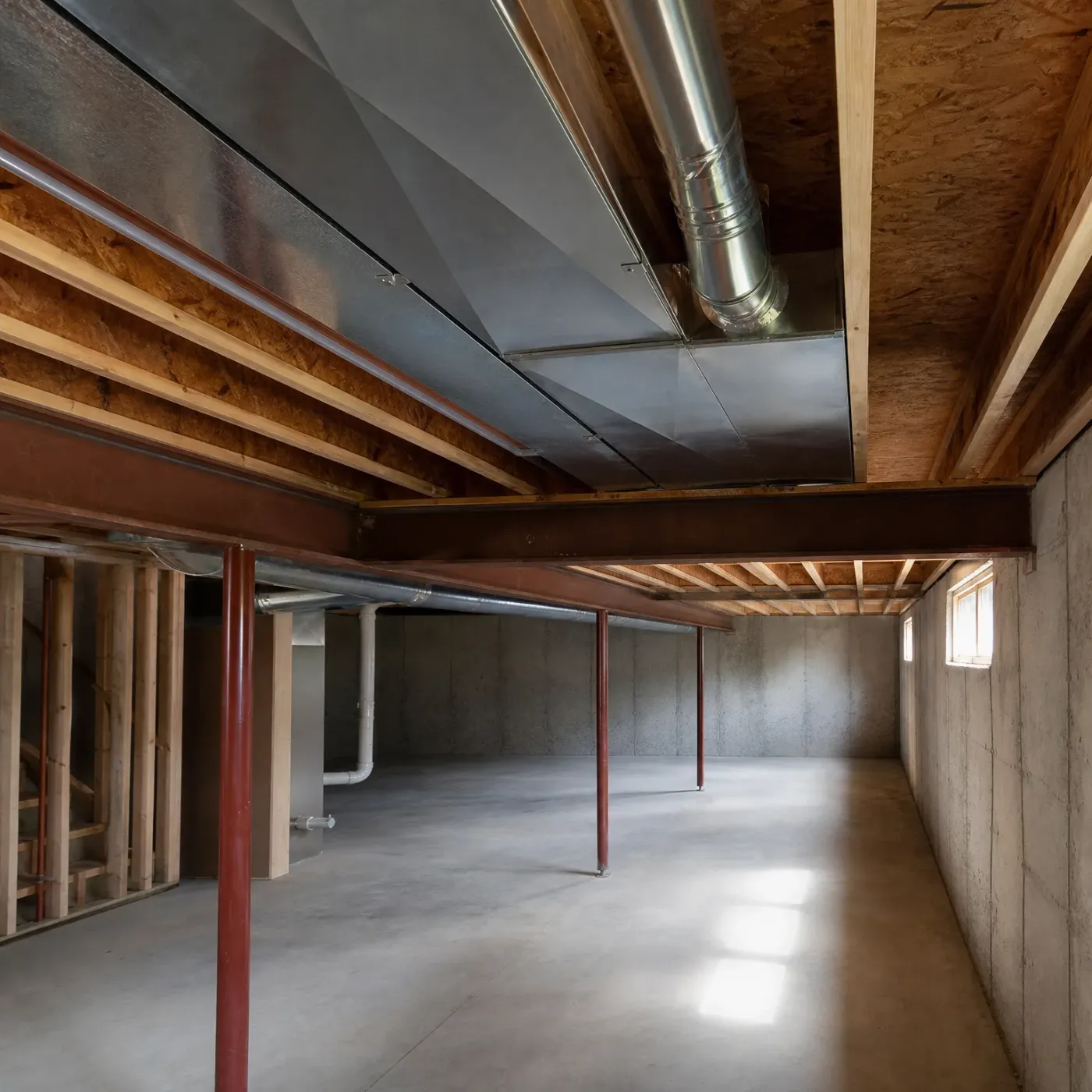
Unfinished basement with bare concrete walls and floor, exposed wood floor joists and steel beams, red support columns, and galvanized metal ductwork and pipes overhead, with a small window on the right.

No calling every shop in Greenville County

Answer a few questions

A licensed pro who works in Greenville County gets your request.

You only hire the pro if you want to.