
Clean ductwork
The metal trunk lines and flex runs stay dry between cycles. No standing moisture on the joists above, no dark spots on the duct surfaces. Air moves through and the basement smells like concrete and nothing else.
You walk past a vent and catch that damp, musty smell, maybe stronger right when the AC kicks on. It's not strong enough to be mold on the wall, but it's there every time the system runs, and you want to know if it's something small you should deal with now or a sign of a bigger problem in the ductwork.
That smell is mildew growing on a damp surface inside your system, most often the evaporator coil or the inside of the ductwork near it. Summers in Horry County are long and muggy, so your AC spends months pulling moisture out of the air, and some of that moisture collects on the coil instead of draining away. Dust and condensation together give mildew what it needs to grow, and every time the blower turns on, it pushes that smell out through the vents into the house. A dirty filter makes it worse by slowing airflow across the coil, which keeps it wetter longer between cycles. Left alone, it stays a smell. Caught early, cleaning the coil and the ducts usually clears it.
The metal trunk lines and flex runs stay dry between cycles. No standing moisture on the joists above, no dark spots on the duct surfaces. Air moves through and the basement smells like concrete and nothing else.

Staining runs along the wooden joists and across the duct surfaces where condensation has sat for a while. That moisture doesn't dry out on its own, and every time the blower kicks on, it pushes that smell up through the vents and into the rooms above.




Half the homes here were built by 1999
Cooling runs May through September here, five months of warm air meeting a cold coil, and that's five months of condensation sitting in ductwork that doesn't fully dry out.
Heat runs November through March
Heat only runs November through March, so for five months the ducts sit closed up and damp with no airflow drying them between cycles.
Cooling runs May through September
Half the homes in Horry County were built in 1999 or earlier, and older duct runs have had more years for moisture to work into the insulation and seams.
ACS 2020-2024 · NOAA nClimDiv 1991-2020
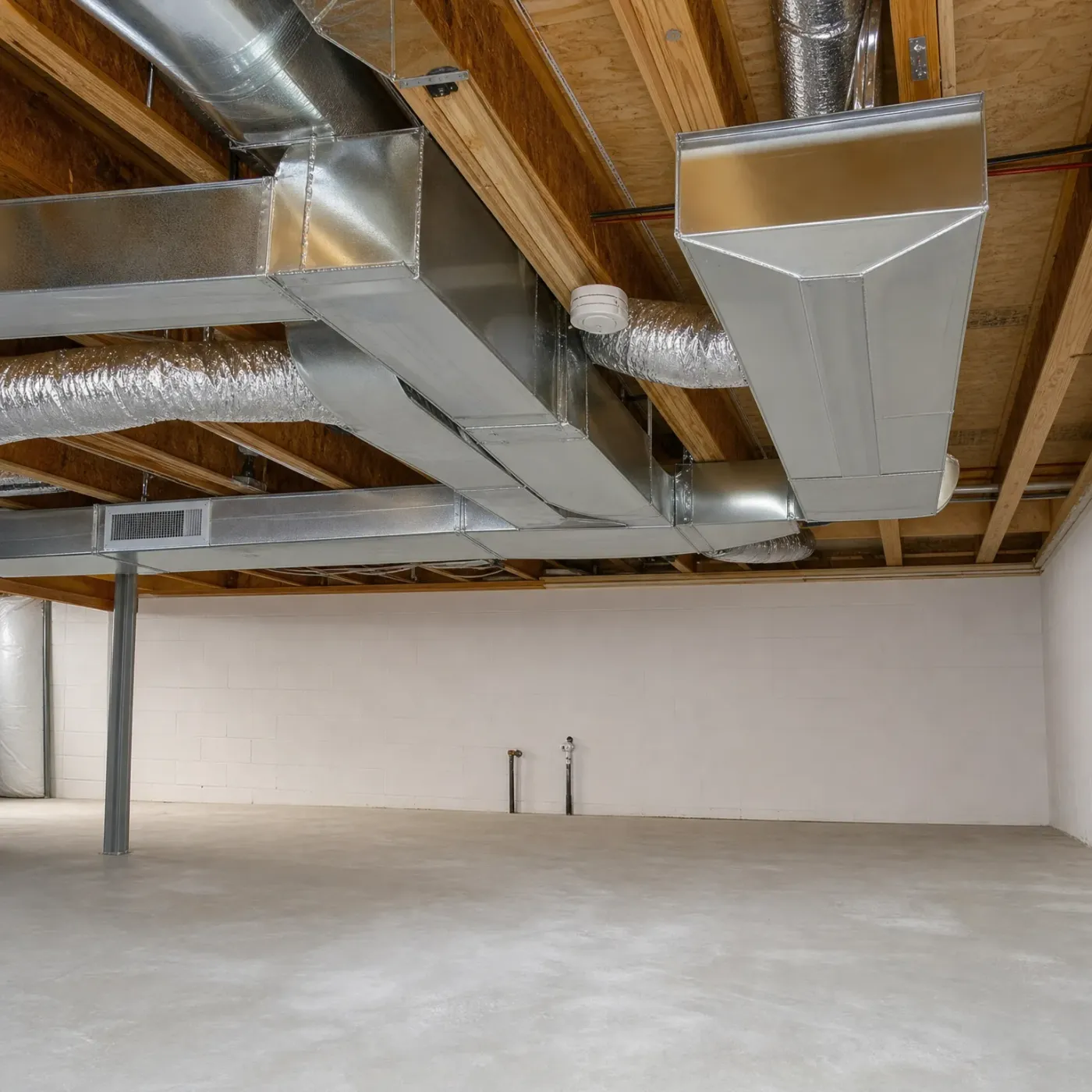
The trunk line and the flex runs above are clean metal and clean insulation, nothing dark on either. The floor joists overhead are bare wood, no staining. Run your hand along the duct and it comes back dry, not damp or gritty.
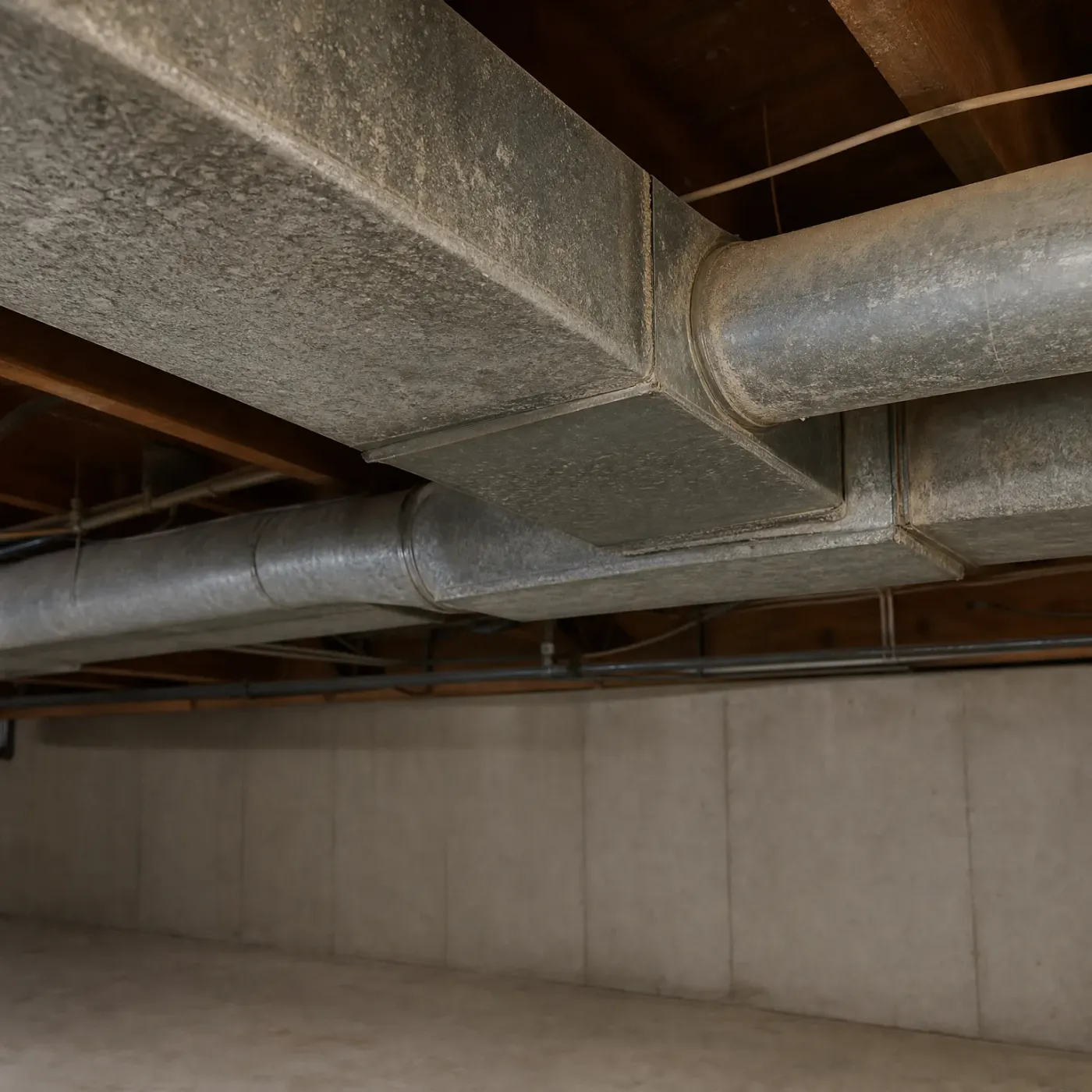
The trunk line here is coated gray, and the round branch duct feeding it carries the same film. That coating sits right where humid air meets cool metal all summer, and it builds up instead of drying off between cycles. Air pulled through this duct picks up what's sitting on it.
Moisture collects on the cold coil as the system runs
Condensate drips into the drain pan below the coil
Damp air carries mold spores into the duct lining
Mold colonies form on duct walls and sit there



It's a Saturday afternoon in April, warm enough that you've had the AC on since lunch. You're vacuuming the living room and look up at the ceiling vent while you work. There's a gray film on the grille, thick enough to see the slats are dusty rather than clean metal. You run a finger along the bottom edge and it comes away dark. The side table under the vent has the same film on it, and you dusted that table last weekend. You stand there a second, looking at the vent, then at the table, and you already know the vacuum isn't going to fix this.
Once you send the form, finding a pro is off your list.
Sending the form costs nothing.
Wipe the grille and spray the register, and the smell is gone for a day, maybe two. Then the AC runs a few cycles and it's back. That's because the source is never the grille. It's the coil, the drain pan, and the duct lining further back, all out of reach of anything you can do from the room. Until that part of the system gets cleaned, the moisture sitting there keeps feeding whatever is growing, and every cycle just pushes more of that air past you.
When a contractor cleans the coil, the drain pan, and the full duct run, there's no leftover moisture left to keep the smell going. Dry metal and a clear drain line don't grow anything new. You'll still get condensation on the coil every time the AC runs in July, that's normal, but it drains off instead of sitting. Months later, the vent air still smells like nothing, not because it got covered up, but because what caused it is gone.
At 13.25 cents a kilowatt-hour, running the blower longer than it needs to run adds up fast over a Myrtle Beach summer. A duct system clogged with mold and dust makes the AC work harder to push air through, and that extra runtime shows up on the bill before you ever smell a thing.
EIA-861 2025
You can live with the smell for now, since it only shows up when the AC runs and nothing else about the house seems wrong.
Mold in a duct system doesn't stop on its own. Every cycle moves more spores through the house, and the colony on the duct wall keeps growing until something gets cleaned.


Most of what causes the smell sits upstream of the register, at the coil and the drain pan, so that's where the work starts. Dust that's settled in the ductwork over months is what mold needs to colonize the duct walls in the first place, not just moisture alone. A contractor working the system hooks a vacuum collection device to one end of the trunk line and runs agitation tools from the other end, pushing loose material toward the vacuum instead of further into the house. Flex runs get treated differently than the metal trunk, since dust cakes onto that inner liner in a way that needs brushing or an air whip to break loose. Worth asking about while someone's in there: the condensate drain line. If it's running slow or clogged, the pan stays wet longer after every cooling cycle, and that extra time wet is extra time for mold to take hold again. Once the cleaning's done, sealing every seam back up matters just as much, since a gap left open pulls attic or crawlspace air into the duct between cycles and undoes the work.


The musty smell from your vents is moisture sitting in ductwork that never gets the chance to dry out, feeding mold that rides the airflow into your rooms every time the AC kicks on. Wiping the grille won't touch it, because the grille was never where it started. It takes someone getting into the trunk line, the flex runs, and the coil and drain pan to actually clear it out. Once you send the form, you're done hunting for who does this kind of work. A contractor who handles duct cleaning in Horry County gets your details and reaches out, and from there it's a conversation about your system, not another search. You don't have to live with catching that smell every time you walk past a vent, and you don't have to figure out on your own who to trust with it either. That part moves off your plate the moment you ask.
After you send the request, you're done searching.